


When Google dropped Gemini 3 Pro on November 18, 2024, I wasn’t expecting much. After all, we’ve seen so many “revolutionary” AI launches this year that it’s easy to get numb to the hype.
But this one hits different. Really different.
The Numbers Don’t Lie (And They’re Wild)
Google’s new flagship model just grabbed the top spot on basically every benchmark that matters. Furthermore, it didn’t just edge out the competition. It crushed them.
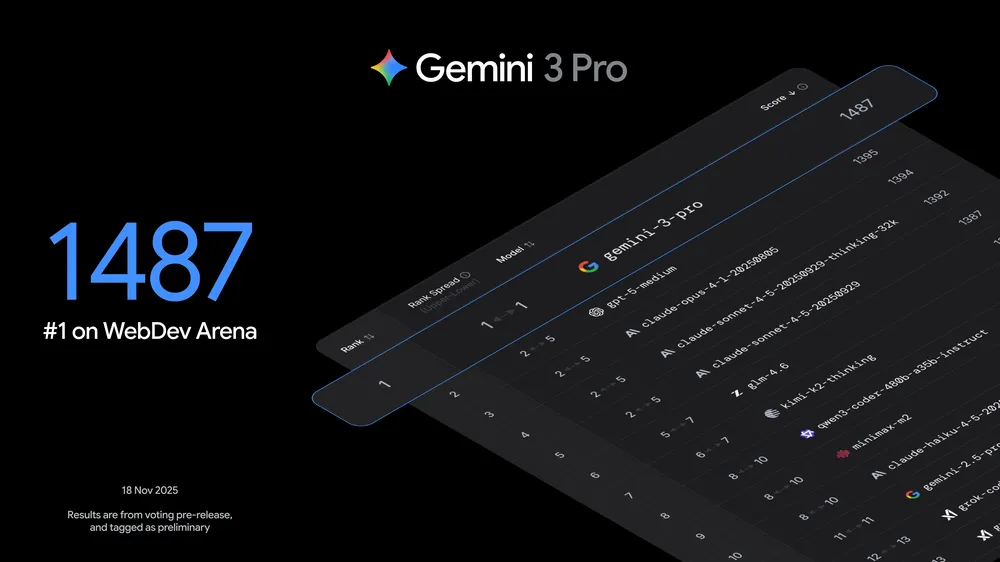
According to Google’s official announcement, Gemini 3 Pro scored 1487 Elo on the WebDev Arena leaderboard. Remarkably, that’s not just first place. In fact, it’s the highest score anyone’s seen on this benchmark.
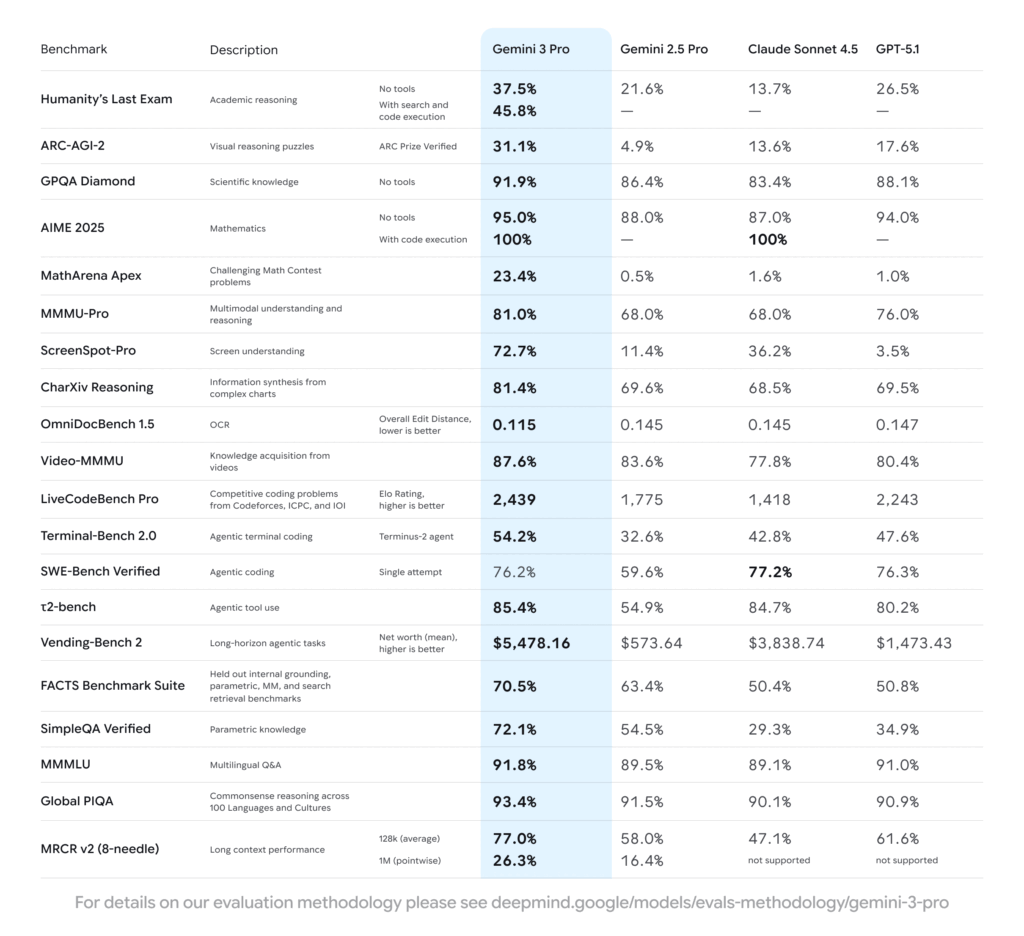
Additionally, the model hit 37.5% on Humanity’s Last Exam without using any tools. Meanwhile, GPT-5.1 managed 26.5%. That’s a gap you can drive a truck through.
What These Benchmarks Actually Mean
Here’s the thing about AI benchmarks. Typically, they can be pretty abstract. However, these specific tests tell us something real about what Gemini 3 Pro can do:
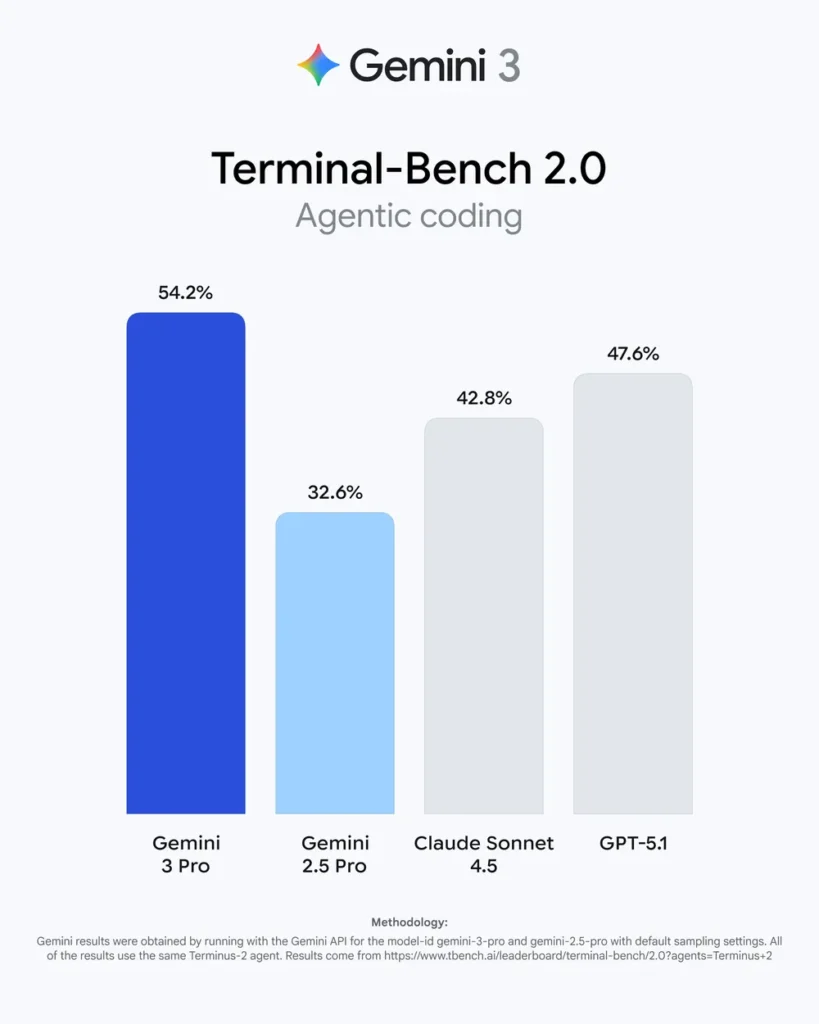
- Terminal-Bench 2.0 (54.2%): The model can actually operate your computer through terminal commands
- GPQA Diamond (91.9%): It demonstrates PhD-level reasoning on scientific questions
- MathArena Apex (23.4%): New state-of-the-art on challenging math problems
- SWE-bench Verified (76.2%): Real-world coding agent performance that beats everything else
Developers Are Actually Freaking Out (In a Good Way)
You know what’s wild? Normally when a new AI model drops, developers grumble about overhyped features. Not this time.
Yi Tay, a Research Scientist at Google DeepMind, tweeted: “This is the best model in the world, by a wild wide margin!” Consequently, the community took notice.
According to VentureBeat’s analysis, Artificial Analysis crowned Gemini 3 Pro the “new leader in AI” globally. Specifically, it scored 73 on their index. Remarkably, Google jumped from 9th place with Gemini 2.5 Pro (which scored 60) straight to first.
For the first time ever, Google has the most intelligent model. Let that sink in.
The Front-End Developer Revolution
Here’s something nobody expected. Surprisingly, Gemini 3 Pro is absolutely dominating front-end development. In fact, developers on X are calling it “the best front-end and web development model ever.”
One prompt. One beautiful, functional website. No back-and-forth. No iterations.
For instance, someone asked it to design a website for an ancient art museum. Consequently, the result was gorgeous. Similarly, another person tested it with intentionally difficult prompts about civilization at Kardashev Scale 3. Unsurprisingly, it delivered.
Notably, the model can generate SVG vector images with animation effects. Additionally, it creates interactive black hole visualizations that run directly in Chrome. Impressively, one tester even got it to compose an original piano piece.
Therefore, front-end developers everywhere are having mixed feelings right now. Excited about the productivity boost, but also wondering what this means for their careers.
What Makes Gemini 3 Pro Actually Different
Every AI company claims their new model is “revolutionary.” Usually, it’s marketing speak. However, Gemini 3 Pro brings some genuinely new capabilities to the table.
Agentic Coding That Actually Works
Interestingly, Google introduced something called Antigravity with this release. Essentially, it’s an agentic development platform. In other words, AI that doesn’t just write code, but plans, executes, and validates entire projects.
Essentially, the agents work across your editor, terminal, and browser simultaneously. First, they break down complex requests. Then, they execute multi-step tasks. Finally, they check their own work.
Consequently, this shifts the developer’s role from writing code to being an architect. You describe what you want. The AI figures out how to build it.
Multimodal Understanding That’s Actually Useful
According to official benchmarks, Gemini 3 Pro scored 81% on MMMU-Pro and 87.6% on Video-MMMU. Admittedly, those numbers might not mean much until you understand what they measure.
Impressively, the model can process text, images, audio, and video simultaneously. Moreover, it maintains context across all these formats. As detailed in TechCrunch’s coverage, a 1 million token context window means it can consume entire codebases.
Remarkably, it captures rapid action in videos with high-frame-rate understanding. Furthermore, it synthesizes narratives across hours of continuous footage. As a result, this unlocks use cases in autonomous vehicles, robotics, and augmented reality devices.
The Timing Couldn’t Be Better (or Worse for Competitors)
OpenAI released GPT-5 in August. Interestingly, many observers called it underwhelming. Subsequently, they followed up with GPT-5.1 last week, claiming it was “smarter” and “more conversational.”
Meanwhile, Anthropic dropped Claude Sonnet 4.5 two months ago. Admittedly, it’s a solid model. Actually, really good.
Nevertheless, Google just waltzed in and grabbed the top spot on virtually every benchmark. The timing is brutal for the competition.
The Real Numbers Behind the Hype
According to Google’s official data, AI Overviews now has 2 billion users per month. Similarly, the Gemini app surpassed 650 million monthly active users. Additionally, over 13 million developers are building with Gemini.
Importantly, these aren’t projected numbers. Rather, they’re current usage statistics. Therefore, Google has distribution at a scale nobody else can match.
What This Means for Regular Developers
You might be thinking: “Cool benchmarks, but what can I actually do with this?” Fair question. Let’s talk practical applications.
Vibe Coding Is Real Now
Google calls it “vibe coding.” Essentially, natural language is the only syntax you need. Simply describe what you want in plain English. Afterwards, the model handles the heavy lifting.
Impressively, it translates high-level ideas into fully interactive apps with a single prompt. However, this isn’t generating boilerplate code. Instead, it creates rich visualizations and deep interactivity.
For example, one developer in Brazil used the preview to build a customer service bot handling 12 languages. Remarkably, no extra coding needed. Similarly, another developer in Canada made a tool converting hand-drawn sketches into working website layouts.
Legacy Code Migration Gets Easier
Typically, many technical teams spend tons of time maintaining brittle legacy systems. Fortunately, Gemini 3 Pro’s agentic coding capabilities can help migrate legacy code and handle software testing.
With that 1M token context window, it can consume entire codebases. Consequently, it understands how different pieces connect. It synthesizes disparate code sections and follows complex instructions.
The Deep Think Mode (Coming Soon)
Interestingly, Google is holding back one more thing. Specifically, Gemini 3 Deep Think mode scored 45.8% on Humanity’s Last Exam with search and code execution enabled. In comparison, that’s compared to 37.5% for the standard Pro version.
On AIME 2025 mathematics problems, Deep Think hit 100%. Meanwhile, on ARC-AGI-2, it reached roughly 45%. Clearly, these are new highs.
However, Google is taking extra time for safety evaluations. Deep Think will roll out to Google AI Ultra subscribers in the coming weeks.
What About the Downsides?
Look, no AI model is perfect. Gemini 3 Pro has issues too. Therefore, let’s talk about them honestly.
Hallucination Rates Still High
According to recent analysis, a new benchmark from Artificial Analysis tested 40 models on factual reliability. Surprisingly, only four achieved positive scores. Ultimately, Gemini 3 Pro led with 13 points.
Nevertheless, it only achieved 53% accuracy on factual questions. Granted, that’s the highest score, but it’s still barely better than a coin flip. For context, meanwhile, GPT-5.1 and Grok 4 both hit 39%.
Overall, the study found high hallucination rates across all models. Unfortunately, this remains a fundamental challenge in AI development.
The Traffic Apocalypse for Publishers
Understandably, Google keeps insisting AI Overviews will connect users to publisher content. However, research shows users rarely click through when AI summaries appear.
Publishers call it a “traffic apocalypse.” Essentially, their click-through rates are getting hammered. Consequently, the business model for online journalism faces an existential threat.
Ironically, Google’s CEO Sundar Pichai even told the BBC people should not “blindly trust” AI tools. Specifically, they’re “prone to errors,” he said. Notably, that’s quite an admission from someone launching the “most intelligent model” ever.
How to Actually Use Gemini 3 Pro Today
Want to try this thing yourself? Here’s how to get access:
- Google AI Studio: Free access with rate limits for testing and prototyping
- Gemini API: Preview pricing at $2 per million input tokens and $12 per million output tokens
- Vertex AI: Full enterprise access with higher limits and support
- Gemini App: Available now with “Thinking” model selector for Pro/Plus/Ultra subscribers
- Third-party tools: Already integrated into Cursor, GitHub, JetBrains, Manus, Replit
Fortunately, for developers, the fastest path is Google AI Studio. Simply click “I’m feeling lucky” and let Gemini 3 Pro handle both the creative spark and code implementation.
The New Generative Interfaces
Interestingly, Gemini 3 Pro unlocks something Google calls “generative interfaces.” Essentially, the model designs custom user interfaces in real-time, perfectly suited to your prompt.
For instance, ask it to “explain the Van Gogh Gallery with life context for each piece.” Subsequently, you’ll receive a stunning, interactive response. Moreover, you can tap, scroll, and learn in ways static text cannot deliver.
Additionally, Google is rolling out visual layout and dynamic view experiments today. Furthermore, the shopping experience got radically improved with product listings, comparison tables, and live pricing.
The Bigger Picture: Where AI Development Is Heading
Gemini 3 Pro represents more than just another model release. It signals where AI development is heading in 2025 and beyond.
The Agent Revolution
Essentially, we’re moving from AI that answers questions to AI that completes tasks. Specifically, Gemini Agent handles multi-step workflows. Furthermore, it connects to Google Calendar, Gmail, and other apps.
For example, ask it to “organize my inbox” and it prioritizes to-dos and drafts replies for your approval. Alternatively, request “research and book a mid-size SUV under $80/day using details from my email” and it handles the entire workflow.
Importantly, however, you remain in control. Specifically, the system seeks confirmation before critical actions like purchases or sending messages. Additionally, you can take over anytime.
The Full Stack Advantage
Google owns the entire stack from hardware to consumer products. First, they design their own TPU chips. Additionally, they control data centers. Furthermore, they have billions of users feeding real-world data back into their systems.
Few companies can match this integrated approach. Consequently, Google can ship AI at a scale competitors can’t touch.
Nevertheless, this also raises questions about centralized power and data privacy. Google’s data foundation is their secret sauce. But that data comes from all of us using their products.
What This Really Means
I’ve seen plenty of overhyped launches. This isn’t one of them.
Gemini 3 Pro represents a genuine leap forward. The benchmarks are impressive. The developer reactions are real. The practical applications are already emerging.
However, we need to be realistic about limitations. Hallucination rates remain high. The technology is prone to errors. It’s not ready to replace human judgment.
The impact on front-end developers will be significant. Moreover, content creators, designers, and knowledge workers should pay attention. These tools will reshape workflows across industries.
Therefore, the question isn’t whether AI will change your work. The question is how you’ll adapt. Will you resist the change? Or will you learn to work alongside these tools?
What Happens Next
Google plans to release additional models to the Gemini 3 series soon. Deep Think mode is coming to Ultra subscribers within weeks. The company is clearly moving fast.
Meanwhile, OpenAI and Anthropic aren’t sitting still. The AI arms race continues at a blistering pace. Each release pushes the boundaries of what’s possible.
For developers, this is an exciting time. The tools keep getting better. The possibilities keep expanding. Nevertheless, the fundamentals of good software development still matter.
AI can generate code. It can’t decide what to build. It can’t understand your users’ real needs. It can’t make strategic product decisions.
Therefore, the most valuable skill isn’t learning to code anymore. It’s learning to think clearly about problems and communicate what you want. The machines can handle the rest.
At the end of the day…
Gemini 3 Pro is impressive. Really impressive. Google finally has the most capable AI model on the market. The benchmarks prove it. The developer reactions confirm it.
However, capability doesn’t equal reliability. High scores don’t mean the technology is ready for every use case. Consequently, approach with enthusiasm but also caution.
Test it thoroughly. Understand its limitations. Use it where it excels. Have backup plans where it struggles.
The AI revolution is here. Gemini 3 Pro just accelerated the timeline. Whether that’s exciting or terrifying probably depends on your perspective.f
Either way, ignoring it isn’t an option anymore.